
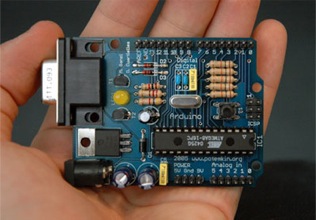
 I spent the weekend over at Chapter where I was introduced to the world of micro-controllers and prototyping using Arduino which was facilitated by the guys from tinker.it.
Now, although I have a very basic understanding of what I just said, I felt it might be a good idea to post some of my experiences and how they might impact on digital inclusion.
I can't really go in to too much depth regarding the concepts as I don't really get them myself yet!
Anyway, the main point of interest for me was around the world and concepts of Physical Computing. It's all about the way in which we are able to interface with computers. The traditional method of mouse and keyboard control which, from the point of view of the computer, means we as users, are perceived by the machine we wish to control as a giant finger and nothing more.
Of course, us users are much more complex than that and therefore there are a multitude of ways we could interface with a machine that allows data to be captured through a number of interfaces; e.g. gestures, sounds, movement, light, distance etc.
It's at this point the world of Arduino, and more specifically micro-controller programming offers an open source way to "go beyond the finger".
The "prototyping board" pictured above will cost around £20 as forms the basis of how the environment can interface with programs and how programs can interface with the environment. There are two open source programming platforms that allow the dialogue; Arduino (software) controls the board and Processing (Software) controls the computer.
These two platforms talk to each other very effectively and allow input via the Arduino board (gestures, actions, knobs, sensors etc.) to be interpreted and used in programs that can display or use that input to control or produce effects on your desktop.
This process also works in reverse whereby actions on your desktop (key presses, mouse movements etc.) can be translated into actions in the environment (switching on lights, activating motor functions etc.).
That all sounds very promising to me, but inevitably I was very soon out of my depth as the world of coding and electronic engineering appeared on the horizon! I've never really understood electronics and the prospect of building circuits was a bit daunting - let alone the idea of programming chips!
So I struggled on through the weekend by falling back on my vast experience of "not really knowing what I'm doing" and eventually built a circuit that controlled a motor I had liberated from an old toy bubble making machine. I wrote the code and made the circuit which to me was extremely exciting; until the guy sat next to me showed me his "etch-a-sketch" machine he'd built and programmed in a couple of hours.
Anyway, going back to digital inclusion...During this whole weekend I felt very much out of my depth as I have no experience in electronics; so all I wanted to know was the answer to the same question we find popping up all the time doing DI workshops: "How do I NOT break this?".
There was a vast amount of strange language coming at me too, only some of which I was able to understand. I made a motor spin and didn't fry my chip, so now I can move on from there; but to see what everyone else made I was really inspired but somehow at a loss to think about how I might do something similar.
I think in summary there are two points coming out of this for our DI work:
1. There is a massive potential with this kit (and the resources I found both online and in terms of the open source minded participants who agreed to share their designs and code) to encourage workshop participants to interact with new technologies in a more "natural", but much more creative way.
2. An awareness of language and approach that can quickly and easily alienate and lose those who have an absolute zero degree of the concepts around new technologies. It can often be the (relatively speaking) smallest thing that inspires.
Finally...as a result of this I'm looking for thrown away bits of tech like keyboards, remote controls, potentiometers (twisty knobs from hi-fi's etc.) and motors/servos that can be recycled to produce new and creative ways of interfacing with the technologies that are at the tip of our massive fingers!

